Code Is The Artifact. Specs Are The Asset.
How AI-augmented development is shifting what developers actually do, and why the next level isn't about writing code anymore.
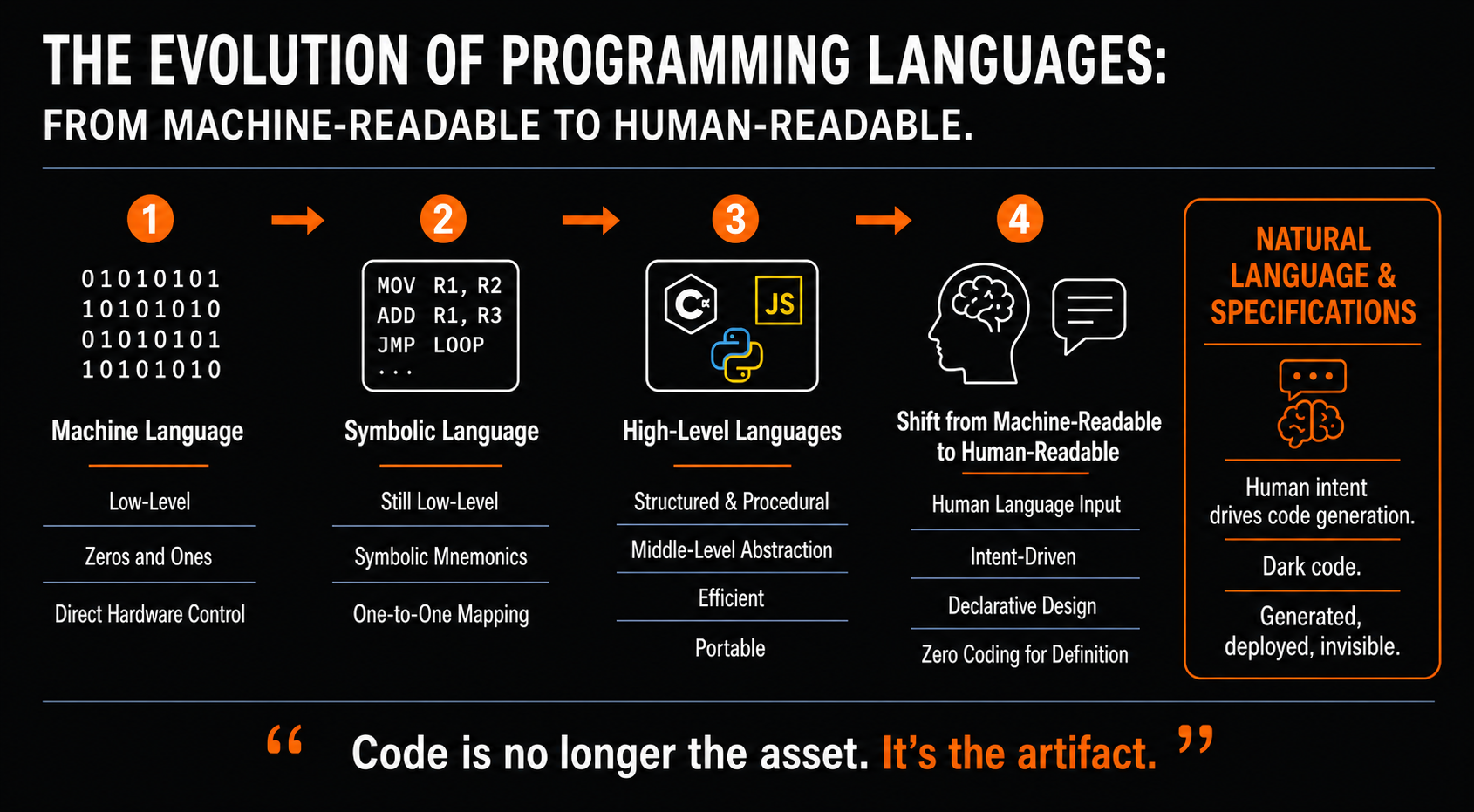
Code used to be what you protected. What you reviewed obsessively. What defined you as a developer. That's over.
We've been climbing a ladder of abstraction for decades. Binary to assembly. Assembly to C and Java. Those to Python and JavaScript. Now we've climbed another rung: plain English.
AI-augmented development means you're not writing code anymore. You're writing specifications. Requirements. Prompts. In plain language. The AI translates that into actual code. Most of it you'll never see. Dark code. Generated, deployed, running, invisible.
Code is now the artifact, not the asset.
But here's where it gets interesting: understanding code still matters. More than ever, actually. Not because you're writing it. Because you're choosing what to review and what to trust. That's taste and judgment. You're not a developer anymore. You're an architect. A system designer. You decide which generated code matters enough to inspect, which patterns you can rely on, where optimization actually moves the needle. You can't review everything or you become the bottleneck. The skill is knowing what to look at and how to stay ahead of the output.
The developers winning are the ones who can spec effectively and judge systems deeply. They've got leverage because they understand both what they're asking for and what to trust in what comes back.
This Pattern Repeats
This isn't revolutionary. It's the same cycle we've seen before.
Binary. Assembly. C. JavaScript. Python. English.
Each step moved the interface further from the machine and closer to human thought. Each time, people said the old way mattered. Each time, those who adapted thrived. Those who didn't got left behind.
Then the economy got better. Humanity built more. We moved on to the next evolution.
You're in that transition now. The game changed. The rules changed. The roles changed.
Every major shift in how we work with machines creates the same pattern. Disruption. Adaptation. Prosperity. The printing press displaced scribes. But then typesetters and editors emerged, and information spread globally. The steam engine displaced manual laborers. But machinery operators were in demand, and mass production unlocked entire industries. Electricity made existing systems obsolete. But those with new technical skills thrived, and global productivity exploded.
This is just the next chapter.
Developers who adapt, who learn to think in specs, who understand how to work with AI tooling, who build judgment about what matters, they're not surviving. They're thriving. Operating at a different magnitude than before. One person now does what it took dozens to do before.
Not because their skill stopped mattering. Because their skill got leveraged.
Think about the machinist who understood metallurgy and the internal workings of machinery. He could build what the manual craftsman never could. It wasn't that craftsmanship died. It was that understanding got amplified by the tool.
Same thing is happening now.
Adapt Or Don't
Your move is simple: adapt or don't.
But if you're wondering whether this is the end of developer expertise, it's not. It's the next level. Different game. Higher stakes. More leverage for those who play it.
The question isn't whether change is coming. It's already here. The question is whether you're learning to play the new game or waiting for the old one to come back.
It won't.
Jehad Alkhateeb
AI & Digital Experience Architect with 11+ years of experience building intelligent systems and leading engineering teams. Based in Toronto, Canada.